We turned a retirement-planning idea into a working app in 3 days
This is what happens when you pair a clear idea with an AI-assisted engineering workflow: no six-week discovery phase, no bloated spec — just a working, polished, genuinely useful application, live on the web in three days.
Below is the app we built: a private, in-browser retirement simulator with Monte Carlo stress-testing, tax modeling, Roth conversion planning, and more — the kind of tool that normally takes a small team weeks to scope, let alone ship.
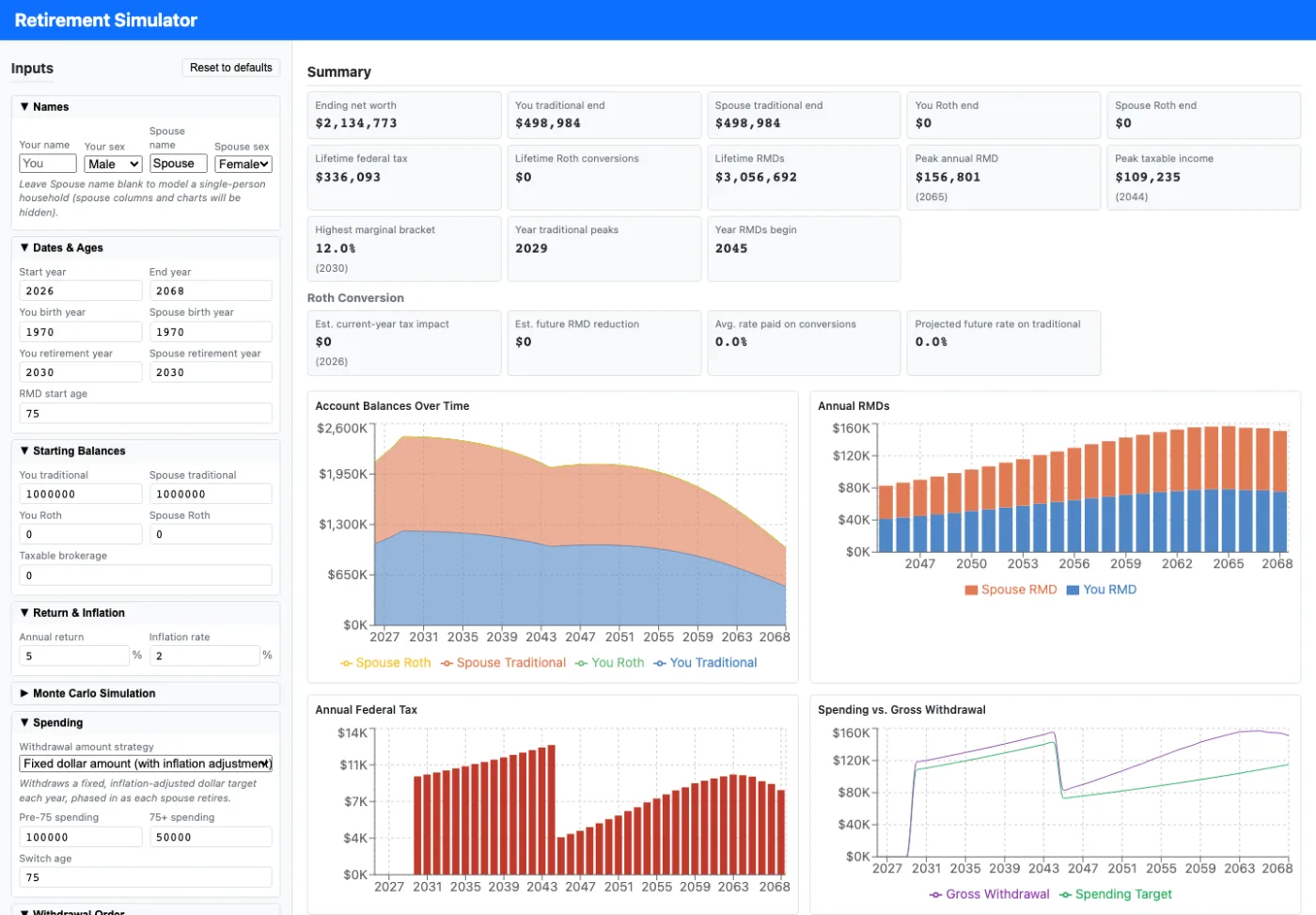
The full dashboard: live summary metrics and four charts that update instantly as you change any assumption.
What the app actually does
The Retirement Simulator is a private, in-browser retirement planner for couples (or individuals) that projects your finances year by year — from today through your 90s — so you can see the long-term impact of your decisions before you make them. Everything runs on your own device: no account, no server, no one else ever sees your numbers.
Plan for two, your way
Model yourself and a spouse side by side, or just yourself. Set each person's birth year, retirement year, and choose your own projection window.
Every account that matters
Traditional and Roth balances for each person plus a shared taxable brokerage account, with your own return and inflation assumptions.
Multiple spending models
Fixed dollar amount, percentage of balance with smoothing, life-expectancy-based withdrawals, or import your own custom sequence.
Smart withdrawal ordering
Choose Traditional-first, taxable-first, RMD-then-Traditional-then-Roth, or Roth-last — and see how each choice changes lifetime taxes.
Roth conversion planning
Model always-convert, post-retirement-only, or automatic bracket-fill strategies, plus a plain-English Roth conversion benefit score.
Guaranteed income & real tax rules
Pensions, Social Security with COLA and IRS-method taxation, editable progressive tax brackets, automatic RMDs, and capital gains modeling.
Monte Carlo stress-testing
Run hundreds of simulated futures across six different market models and see a portfolio survival rate, not just one optimistic line.
Private, automatic, everywhere
Your plan autosaves to your device as you type — no login, ever. Use it in any browser, or install the native macOS and Windows apps.
Stress-test your plan against real market history
Instead of a single "average" projection, the simulator can run hundreds — or thousands — of simulated futures using randomized historical S&P 500 returns (1871–2022), forecasted assumptions, a multi-asset statistical model, or your own custom distribution. Results include a portfolio survival rate and a percentile fan chart showing the full range of likely outcomes.
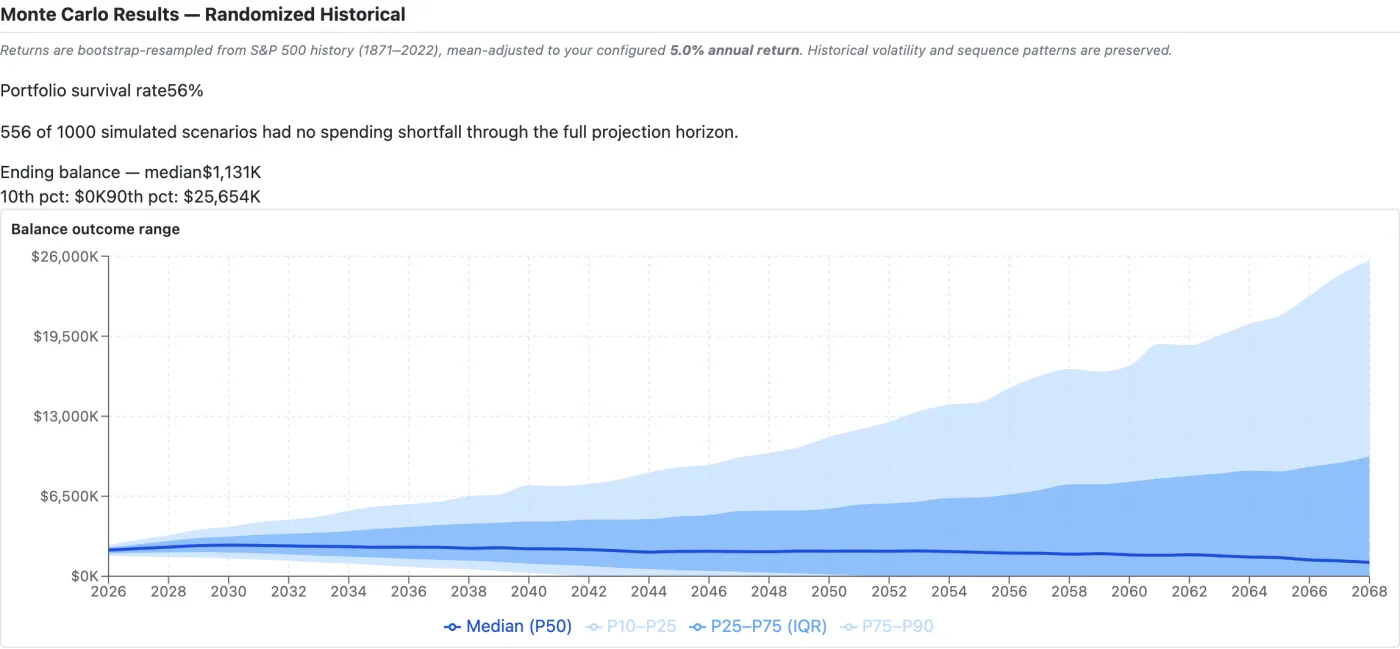
1,000 simulated retirements, run in seconds, right in the browser — with a clear survival rate and outcome range.
Granular control, full transparency
Every assumption is editable — and every number in the projection is visible. Nothing is a black box.
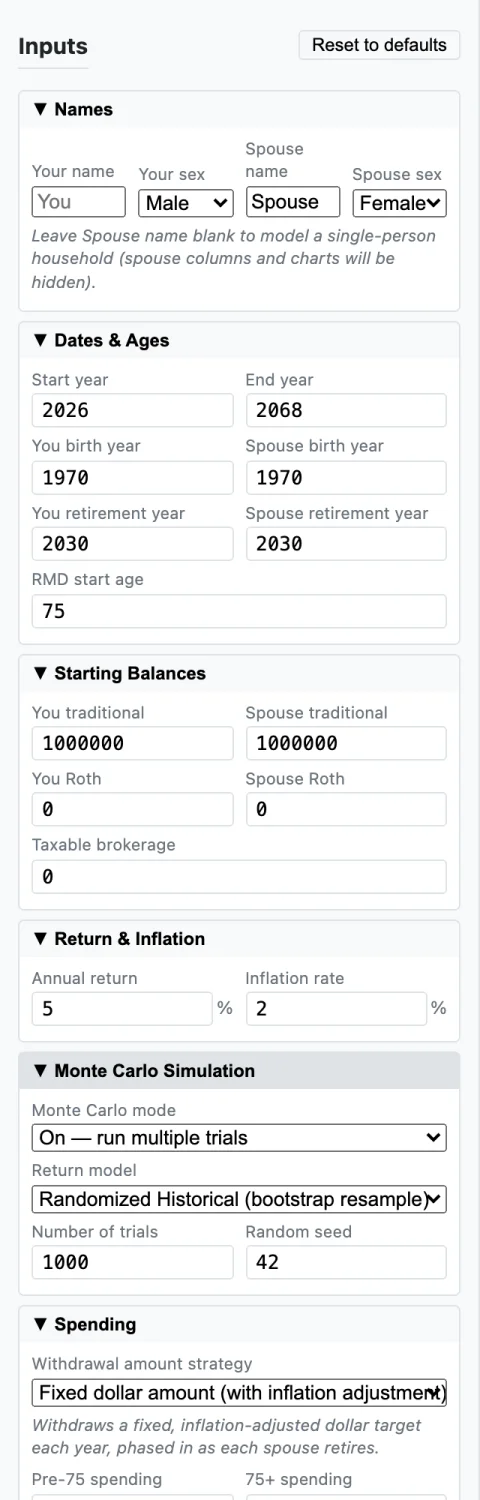
Organized, collapsible input groups for every assumption in the plan.
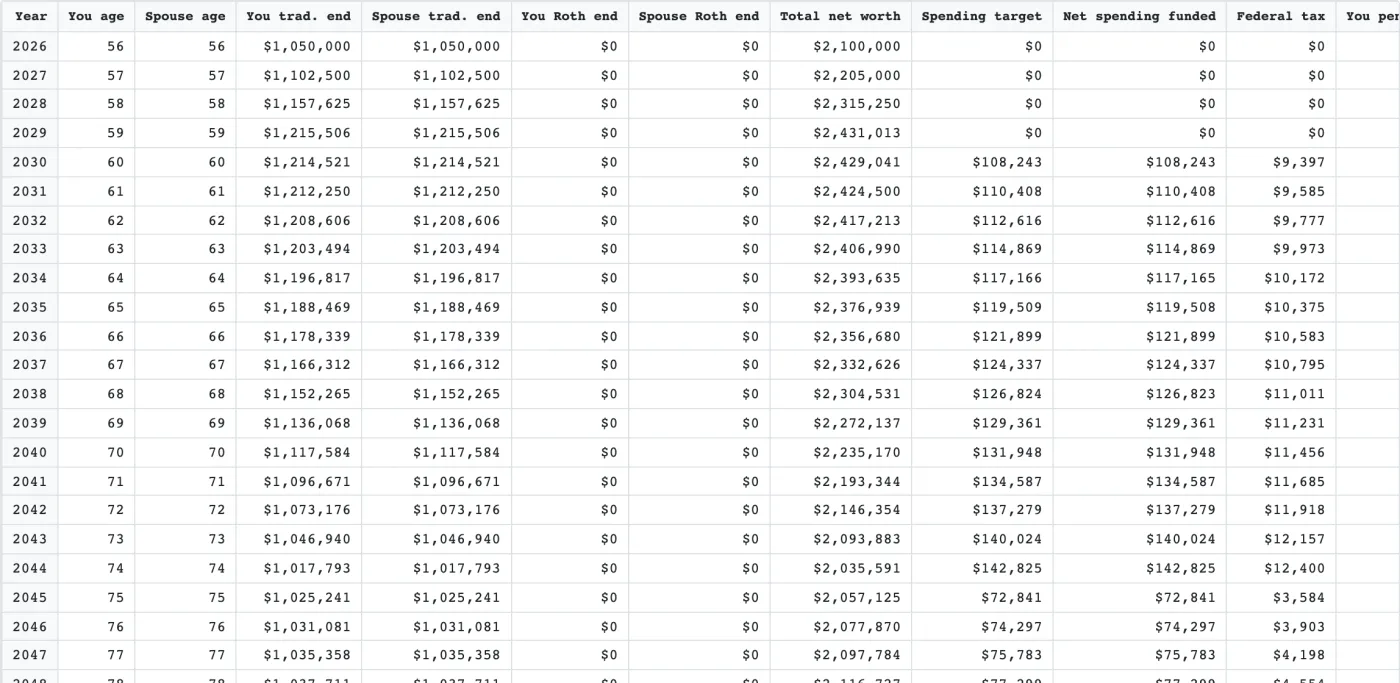
A full year-by-year table with every underlying number — exportable to CSV for your own analysis.
How we shipped it in 3 days — the AIgile method
This wasn't a stripped-down prototype — it's a genuinely complete tool with real tax logic, real Monte Carlo simulation, and a polished UI. We didn't get there by skipping rigor; we got there by compressing the calendar time that rigor normally takes. That's the whole idea behind how we work.
Standard Agile software development — user stories, iterative delivery, continuous verification — turbocharged by AI at every stage of refinement, not just code generation. Ideas are pressure-tested into engineering specs, gap-analyzed for what's missing, and checked against QA criteria before a full project plan is handed to AI agents to implement.
From idea to project plan, refined in hours instead of weeks
The output of each stage becomes the input to the next, so nothing gets implemented until it's been questioned, checked, and made concrete.
Ideas & user stories
Capture the goal in plain language: what should this do, for whom, and why does it matter?
Engineering specs
User stories are refined into a concrete technical spec — data model, architecture, behavior, and constraints.
Gap analysis
The spec is checked against itself and the real world: what's missing, what conflicts, what got assumed that shouldn't have?
QA checks
Acceptance criteria and test plans are written up front, before any implementation code exists — not bolted on afterward.
Project plan
Stories, spec, and QA checks compile into a sequenced, dependency-aware plan of concrete work items.
Agent implementation
AI coding agents execute the plan task by task, with engineers reviewing and steering at every checkpoint.
Applied to this project
Same method, compressed into three days because the scope was well-defined enough to move through every stage quickly.
Stories, spec & core engine
Turned the idea into user stories and an engineering spec — accounts, spending strategies, withdrawal ordering — then had agents implement the year-by-year projection engine against that spec.
Gap analysis → tax rules & Monte Carlo
Gap analysis surfaced the real-world edge cases worth handling: RMDs, Social Security taxation, bracket-fill conversions, and six market models for stress-testing. Agents implemented each against QA-defined acceptance criteria.
QA → polish, package, ship
Final QA checks against the project plan, then the dashboard UI, CSV export, native macOS/Windows packaging, and deployment — built and verified the same day.